They're not that different from you, are they? Same haircuts. Full of
hormones, just like you. Invincible, just like you feel. The world is
their oyster. They believe they're destined for great things, just like
many of you, their eyes are full of hope, just like you. Did they wait
until it was too late to make from their lives even one iota of what
they were capable? Because, you see gentlemen, these boys are now
fertilizing daffodils. But if you listen real close, you can hear them
whisper their legacy to you. Go on, lean in. Listen, you hear it? - -
Carpe - - hear it? - - Carpe, carpe diem, seize the day boys, make your
lives extraordinary.
John Keating from Dead Poet's Society
The dogs, Sammy and Tobie, and I spent a cloudy spring Sunday driving through the southern part of Greenwood County. Sammy is a German Shepherd, Tobie is part Australian Shepherd and part Mountain Cur. Me, I guess I am a mix breed too, but then aren't we all? My wife and kids just call me a cranky old man. But I am not all that old and I don't think of myself as cranky.
The dogs like car trips because they run free through the fields of grass and flowers and splash in the streams. Being city dogs, they don't always know what to make of the cattle and horse. I like the solitude of history.
The dogs and I live in Wichita, Kansas. We do our best to get along with the wife and kids, but it isn't always easy.
Wichita is the largest city in the state of Kansas. Founded in 1870, it has grown from cow town on the Chisholm Trail to a leading manufacturer of airplanes. It is also home to Koch Industries, a privately held by Charles and David Koch and based in Wichita. Koch has subsidiaries in manufacturing, trading and investments. Charles and David Koch - one lives in Wichita, the other in New York - own Invista, Georgia-Pacific, Flint Hills Resources, Koch Pipeline, Koch Fertilizer, Koch Minerals and Matador Cattle Company, to name a few.
Wichita is also home to the Wichita State University, whose men's basketball team came within a hair's breath of beating Louisville in the 2013 NCAA basketball tournament in Atlanta. But enough bragging about one's home town.
If you leave Wichita and head east on Highway 400, the trip takes you into Butler County, past Augusta, Leon, and Beaumont. The road gently rises through the Flint Hills and off to the right and left, where the highway has cut through the hills, you can often see the layered chert and limestone that lies below the soil. Beaumont is at the summit of the Flint Hills. In fact, its hotel was once called the Summit, before taking on the name Beaumont.
 |
| detail Greenwood County, Kansas Atlas 1903 |
Greenwood County begins at the eastern boundary of Beaumont. From there the highway descends down into the Otter Creek valley. The old Frisco railroad which used to parallel the highway is now gone and its tracks removed. Today, the population of Greenwood barely tops 6,600. And that wouldn't even fill Charles Koch Arena where the Shocker basketball team plays. At its peak, when the Frisco ran, the population stood at 16,495. It has been down hill since then.
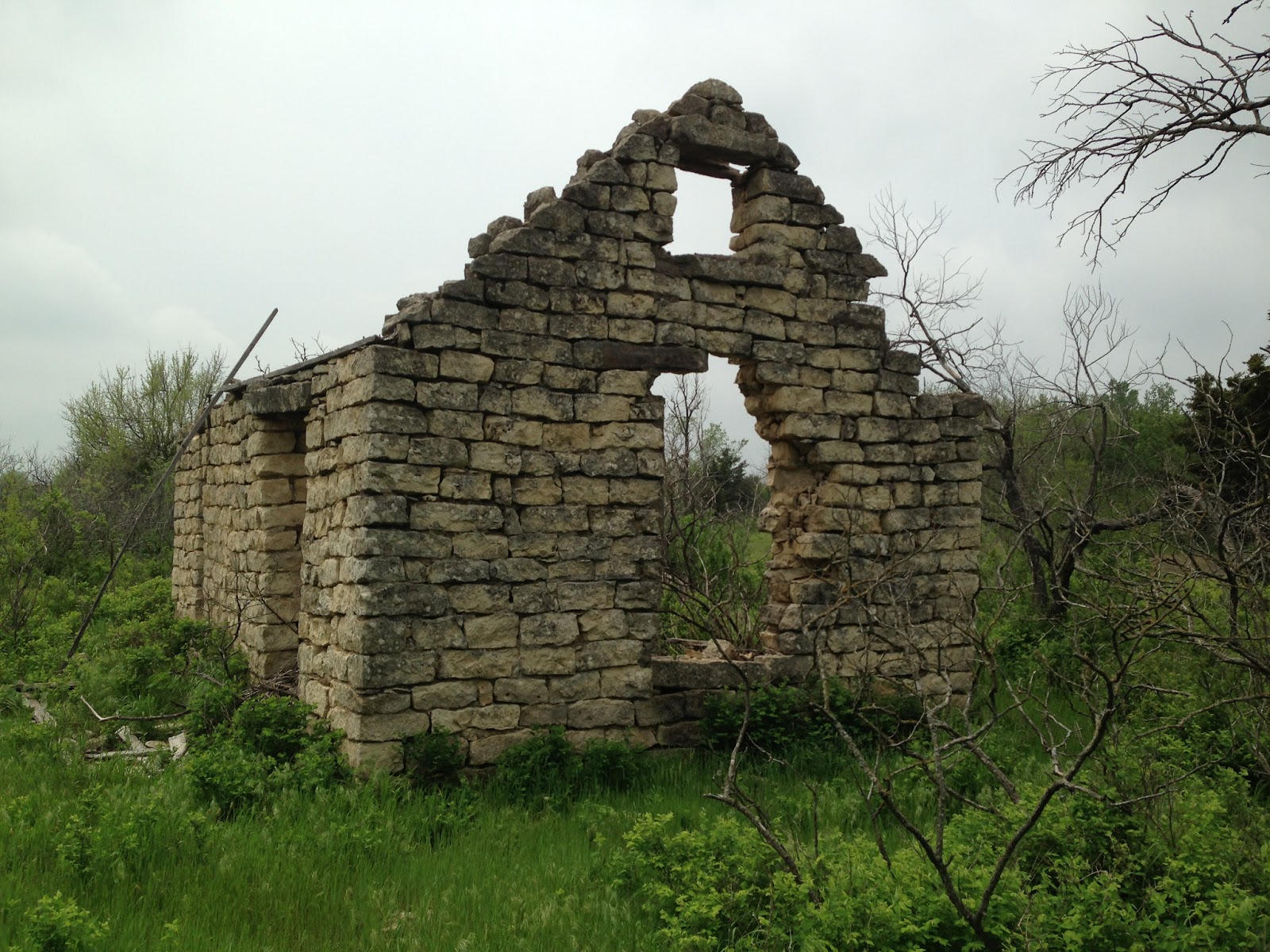
Just inside Greenwood County, down the hill from Beaumont near one of the many rivulets that form Otter Creek, sits an abandoned limestone one room schoolhouse, number 83. Only two sides of the school remain. The doorway on the north has fallen down as has the roof and west wall. This must count as the smallest school in Kansas. I imagine that two children standing shoulder to shoulder with arms stretched out could touch from side to side. From the Kansas Atlas for 1922, I discovered that the school sat on land belonging to James and Anna Edgar. But that is all I have discovered. The story of the school and its students is lost to history.
 |
| Kansas' smallest schoolhouse, no, 83, Greenwood County |
Sammy and Tobie enjoyed the break from the monotony of the car. Nearby a spring flowed fresh water from the hills and a creek flowed clear water. As with all spring water, it was cool and clear.
Railroads change names frequently. And the Frisco railroad has had many names over its lifetime. During its time in eastern Kansas, the Frisco was officially known as the St. Louis & San Francisco Railroad. The St. Louis part was real but San Franciso was a dream, for the tracks never got to the west coast. In Kansas, before the climb to Beaumont and on to Wichita, the Frisco had stops in Piedmont and Severy. Piedmont, as the name suggests, is at the foot of the Flint Hills, before the climb to the summit at Beaumont. Severy is another 10 miles east. Beaumont, Piedmont, and Severy were all railroad towns, meaning they thrived because of the railroad and the business it brought.
 |
| Piedmont 1902, Kansas Atlas, Greenwood County 1902 |
If you have the time, visit Piedmont.
By Mapquest.
Highway 400 does not announce the turn off to Piedmont in large letters. The city sits about a mile off the new highway, tucked back in the trees, lost in time. Piedmont, once a booming town of 300, now is down to less than 100. Once it had a hotel, a grocery store, and other businesses. Now it has none.
 |
| Piedmont High School, 1922 |
Piedmont certainly has, or perhaps "had" is a better word, the largest high school for a city its size. This abandoned three story structure could have housed the entire city and then had room for more. The roof is gone, so are the students.
Empty schools get me to think, and my thoughts eventually took me to the 1989 movie
Dead Poet's Society where English teacher John Keating (played by Robin Williams) inspires his students to a love of poetry and to seize the day.In one memorable scene he takes his students out into the hallway and to the trophy cases. There are all the golden trophies attesting to the physical prowess of the high schools sports teams. There are all the team photos. And when the students lean in to peer at the images and faces of the students gone by, is when the teacher whispers "
Carpe diem, sieze the day boys."
 |
| Kansas Atlas 1922, Greenwood County |
I didn't have the old yearbook for Piedmont High School. I did find online the
Kansas Atlas 1922 for Greenwood County. And in the back of the book are a few reminders of the people who once proudly called Greenwood County home.
 |
| John Howland, family |
|
 |
| Cedar Lawn Stock Farm, Severy, Kansas |
|
You have to take your time, you have to look closely, but they are saying the same thing as John Keating, "
Carpe diem, sieze the day."
Sammy Tobie and I enjoyed Piedmont. What is not to like about a city where the dogs can run loose, where a dad can take his son four wheeling down the main street, where everyone knows your name, and strangers are welcome, if you are friendly in return.
Down the road to Severy, it is not a far piece to drive. Back in the day, buy horse and buggy, it would take an hour. When cars started arriving in Greenwood County around 1910, the trip was shortened to half the time, but only if the car didn't get stuck in the mud on the dirt roads.
Severy too has been bypassed by Highway 400. To get there one has to leave the fast lane and take the old county road one mile. Severy is larger than Piedmont. It has a grocery store, a cafe, even a burger place, and several businesses which keep the town thriving despite the loss of the railroad.
As I turned my car around to go home, one other thought struck me - that is that even as I watch these once thriving towns grow smaller, it is a testament to the passing of time. "To everything there is a season," as Ecclesiastics says. The rugged settlers who came to Greenwood County in the 1870's themselves replaced an older group of people. Though it is not marked, Highway 400 marks the route of the Osage Indian Trail. And along this same highway four times a year the Osage Indians would travel to the hunting grounds of the buffalo along the Walnut and Arkansas river valleys.